Science
Science Curriculum Statement
‘We should not teach children the Scientists, but give them a taste for them.’ – Jean Jacques Rosseau
Intent
At St Mary’s, we recognise how Science impacts every aspect of daily life, and without science, humankind would not have made progress throughout history. As one of the core subjects taught at primary level, we give the teaching and learning of Science the prominence it deserves.
Learning Science is concerned with increasing pupils’ knowledge of our world, and with developing skills associated with science as a process of enquiry. Our Science curriculum develops the natural curiosity of each child no matter their demographic, encourages them to have respect for living organisms, and instil in pupils the importance of caring for the natural environment.
- We believe that a high-quality Science education provides the foundations for understanding the world through the specific disciplines of biology, chemistry and physics.
- We believe that Science has changed our lives, is vital to the world’s future prosperity, and all pupils should be taught essential aspects of the knowledge, methods, processes and uses of science.
- We encourage children to formulate their own questions about the natural world and have the confidence to make predictions and suggest their own theories.
- We promote an awareness of the importance of teamwork in scientific experimentation and practically investigate children’s questions using various methods of enquiry.
- We intend to provide all children regardless of ethnic origin, gender, class, aptitude or disability, with a broad and balanced science curriculum.
- We promote the Sciences so we are preparing the children for the future.
At St Mary’s, we encourage children to be inquisitive throughout their time at the school and beyond. The Science curriculum fosters a healthy curiosity in children about our universe and promotes respect for the living and non-living. We believe Science encompasses the acquisition of knowledge, concepts, skills and positive attitudes.
Implementation
Teachers create a positive attitude for Science within their classrooms and reinforce an expectation that all children can achieve high standards in Science. We endeavour to ensure that the Science curriculum we provide will give children the confidence and motivation to continue to further develop their skills into the next stage of their education and life experiences.
We do this through the following:
- Science will be taught as set out by the year group requirements of the National Curriculum. This is a strategy to enable the accumulation of knowledge and allows progress in repeated topics through the years. Teachers are expected to teach Science at least once a week at St Mary’s.
- Staff ensure that all children have access to high quality teaching and learning experiences, which allow children to explore their outdoor environment and locality, thus developing their scientific enquiry and investigative skills. They are immersed in scientific vocabulary, which aids children’s knowledge and understanding not only of the topic they are studying, but of the world around them.
- Through our planning, we involve problem solving opportunities, allowing children to find out for themselves how to answer questions in a variety of practical means. Children are encouraged to ask their own questions and be given appropriate equipment to use their scientific skills to discover the answers.
- Engaging lessons are created with each lesson having both practical and knowledge elements. Teachers use questioning in class to test conceptual knowledge and skills and children are regularly assessed to identify those children with gaps in learning. This is done by following the White Rose Science scheme.
- We build upon the learning and skill development of previous years. As the children’s knowledge and understanding increases, and they become more proficient in selecting and using scientific equipment, collating and interpreting results, they become increasingly confident in their growing ability to come to conclusions based on real evidence.
- Throughout the programmes of study, the children will acquire and develop the key knowledge that has been identified within each unit and across each year group, as well as the application of scientific skills.
- All children are encouraged to develop and use a range of skills including observations, planning and investigations, as well as being encouraged to question the world around them and become independent learners in exploring possible answers for their scientific based questions.
- Working Scientifically skills are explicit in lessons to ensure these skills are being developed throughout the children’s school career and new vocabulary and challenging concepts are introduced through direct teaching. This is developed through the years, in-keeping with the theme of the lesson.
- Teachers demonstrate how to use scientific equipment, and the various Working Scientifically skills in order to embed scientific understanding. Teachers find opportunities to develop children’s understanding of their surroundings by accessing outdoor learning and workshops with experts e.g. during Science Week and the visit of Sublime Science.
- The science curriculum is flexible in how it is taught at St Mary’s. We look for opportunities for how we can make links with cross curricular subjects – e.g. Year 5 Reproduction and Life Cycles being taught in the summer term.
- Children are offered a wide range of visits, trips and visitors to complement and broaden the curriculum. These are purposeful and link with the knowledge being taught in class e.g. Year 2 and 3 visiting the Science Museum and Year 1 visiting Kew Gardens.
- Regular events, such as Science Week, allow all pupils to come off-timetable, to provide broader provision and the acquisition and application of knowledge and skills. These events often involve the wider community.
- Make links between Science and other subjects.
- Science is taught consistently, once a week, for up to two hours, but is discretely taught in many different contexts throughout all areas of the curriculum. For example, through English, e.g. writing an explanation text on the journey of blood in the body.
- In the EYFS, we strongly believe in first-hand learning experiences, valuing the importance of the outdoor environment to develop children’s critical thinking and problem-solving skills. Science is taught through the ‘Understanding the World’ area of the EYFS Curriculum. The key components of the EYFS curriculum include:
- Child-Initiated and Adult-Led: Science is integrated into play-based activities and specifically planned lessons.
- Cross-Curricular: It is often taught through topics that link to literacy, numeracy, and geography.
- Hands-on Experience: Practical experiments, such as sorting materials or observing plants, are essential.
Impact
Our Science Curriculum is high quality, well thought out and is planned to demonstrate progression. If children are keeping up with the curriculum, they are deemed to be making good or better progress. In addition, we measure the impact of our curriculum through the following methods:
- Book looks
- Pupil voice
- Regular feedback each lesson
- Regular Science assessments completed at the end of each topic. This data is then added to the whole school science tracker.
The successful approach at St Mary’s results in a fun, engaging, high-quality Science education, that provides children with the foundations for understanding the natural world. Our engagement with the local environment ensures that children learn through varied and first-hand experiences. Frequent, continuous and progressive learning outside the classroom is embedded throughout the Science curriculum. Children learn the possibilities for careers in Science as a result of our community links and connection with national agencies such as the STEM association. Pupil voice is used to further develop the Science curriculum, through questioning of pupil’s views and attitudes to science to support the children’s enjoyment of science and to motivate learners. We also like to showcase the amazing work the children complete at St Mary’s. Through Class Dojo, we share these examples with parents to view. We also use Class Dojo as a motivational tool for the children to gain points for their work in class. The children take pride in their work and enjoy seeing how many Dojo points they have achieved in class. In the EYFS,progress is assessed through observations of how children approach problems, use vocabulary, and discuss their ideas.
Curriculum Map
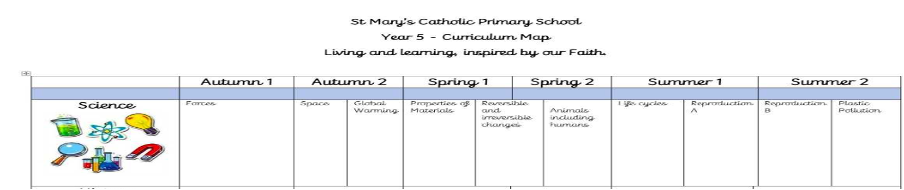
Please find below our curriculum map for this academic year showing the coverage of science across the year groups.
| Term | Year 1 | Year 2 | Year 3 | Year 4 | Year 5 | Year 6 |
|---|---|---|---|---|---|---|
| Autumn 1 | Animals, including Humans | Living Things and their Habitats | Plants | Living Things and their Habitats | Earth and Space | Electricity |
| Autumn 2 | Seasonal Changes | Animals, including Humans | Light | Electricity | Forces | Animals, including Humans |
| Spring 1 | Plants | Uses of Everyday Materials | Forces and Magnets | Animals, including Humans | Properties of Materials | Evolution and Inheritance |
| Spring 2 | Seasonal Changes | The Environment | Rocks | States of Matter | Scientists and Inventors | Light |
| Summer 1 | Everyday Materials | Plants | Animals, including Humans | Sound | Living Things and Their Habitats | Living Things and Their Habitats |
| Summer 2 | Seasonal Changes | Seasonal changes | Each topic is extended by a week to ensure all units are covered. | Scientists and Inventors | Animals Including Humans | Scientists and Inventors |